Showing posts with label music. Show all posts

Thursday, 10 November 2016

Review: Killing Joke, Brixton Academy, 4.11.16

For some time, the legendary Killing Joke have been ageing like a fine wine, albeit one spiked with nerve poison. Defiant in the face of the natural aging process, the band – possibly in reaction to volcano-throated frontman Jaz Coleman’s doomsaying, prophetic lyrics actually being more relevant by the day – have only gotten louder, darker and better as the years have passed.

It is a good fortune and seemingly never-ending winning run only afforded to the truly special and prosperous, with fellow national treasures Iron Maiden being an immediate example – also having a back catalogue so crammed with gems a truly perfect setlist is impossible.

Nevertheless, they give it a bloody good go. From the minute the lumbering, shuddering nightmare of The Hum fills the equally historic Brixton Academy, the ‘Joke give a faultless lesson in how to keep any heel-snapping protégés away. Indeed, when they finally hang it up it’ll be hard to find an act with quite the same weird allure or blazing intensity.


1980s hit and deathless set-staple Love Like Blood follows, throwing back to their historic gothy-pop period and reminding us all of their expeditions into varying genre territories: the enduring, endearing result is, for the uninitiated, a nerve-racking proto-something or other that’s too heavy to be punk, too nuanced to be industrial, and not quite metal either, yet they outwit many of the greatest proponents of these genres by (still) being stubbornly uncategorisable and seamlessly blending them together, without losing sight of what constitutes a tune.

Stringsman ‘Geordie’ Walker, the immovable object against which Jaz Coleman’s unstoppable force collides, provides great textural cathedrals of sound with an utterly unmistakable and sought-after guitar tone, making the noise of thousands from only one pair of hands.

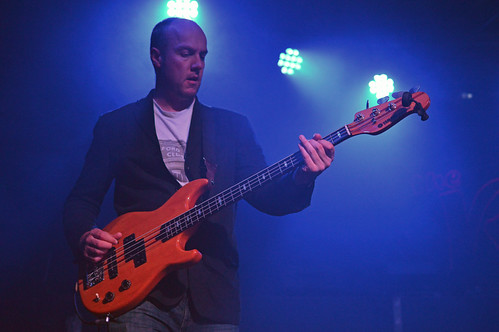
Legendary producer and bassist Youth is almost his complete opposite, stage left: barefoot, in a kimono, and grinning his teeth out, and why not? Most bands never make it past the big 3-0, most never manage to retain or reform their original lineup and sound this fantastic (the tragic passing of longtime bassist Paul Raven having preceded this, however, with the band taking a long hard look at their own mortalities and making the decision).

But Killing Joke are not ‘most bands’, and in a world of absolute fucking anaemic grey-arsed musical tedium they have only become more vital and desperately needed. New Cold War, from last year’s barnstorming Pylon album, ably explores its title’s subject matter like an essay set to music, with Walker supplying chilly atmospherics. They somersault into territories other bands refuse to enter.


Underpinning all of this sits the formidable ‘Big’ Paul Ferguson, a mesmerising sight during the rabbit-hole tumble of Unspeakable and, well, at any given point during the gig. It’s a testament to the man’s dizzying tub-thwacking that he can command your attention even with a pair of fire dancers blowing flames within singeing distance of Youth’s dreads.


The generous running time amounts to nearly twenty songs, and while some stones are left unturned, there’s room for the likes of Eighties, the venerable Turn to Red, underrated dancey banger European Super State, while failsafe early ‘uns like The Wait and Change square off against the furious Dawn of the Hive and I Am the Virus.

A delicious hat-trick of The Death & Resurrection Show, Wardance and a multi-dimensional Pandemonium ensure a winning send-off to a night of energy, dancing, sore necks and smiles all round.

Killing Joke, after thirty-plus years in the game, are still impossibly unique and utterly unsolvable. We shall not see their like again.

Friday, 7 October 2016

Review: Opeth's 'Sorceress' casts its spell

Soldiering on through their new growl-free era, Opeth have either musicially neutered themselves or continued to push progressive boundaries with quality music, depending on who you ask.

Splitting their fanbase down the middle with 2011’s infamous (but really rather good) Heritage album, guttural growls and heavy riffing went out in the window in favour of a greater emphasis on haunting, autumnal atmospherics and slight noodling, all drenched in 70’s worshipping prog.

This turned away a sizable number in disgust, with the rest (and music publications) praising the resultant music for what it was, rather than what it wasn’t: and crucially, it was really fucking good. 

The same was said of 2014’s Pale Communion, which tumbled deeper down the prog rabbit-hole.
The naysayers can be forgiven, however, for while both Heritage and Pale Communion were excellent slabs of music in themselves, there was certainly something strangely different. 

Where the likes of past albums Blackwater Park, Still Life and Ghost Reveries were genuinely awe-inspiring, almost maddeningly inventive works hitting a high clang on the how-did-you-do-that register, Heritage and onwards are merely really-quite-good in comparison, destined to occupy an interesting spot in Opeth’s gleaming back catalogue but never to knock the twin giants of Ghost Reveries and Blackwater Park off their (deserved) high perches.

With this in mind (and in one’s ears), 2016 brings us the mysterious Sorceress. Boasting a title-track with the first heavy riffing of any kind since 2008’s Watershed, this new gilded release, essentially, continues onward from Pale Communion – as it should.

A straightforward return to death-metal stylings would carry a 99% chance of being an obvious rehash and lazy genre-milking, so hats must come off to Mikael Akerfeldt and co. for having the confidence to writing from the heart with more deliciously classy prog-rock.

So to an extent, the listener knows what to expect – piano, acoustic guitar, tasteful flute, looming keyboards, etc – and is rewarded in kind with more achingly beautiful instrumentation, inspired passages, haunting melodies and Akerfeldt continuing to be one of rock and metal’s most favoured sons.

Simply put, the quality bar is still endearingly high and Opeth have reliably rewarded those deciding to stick with them in a brave new musical world. Their classic past albums will always exist for those who prefer them, and the band have long since earned the right to do whatever they damn well please, and the results are fantastic.


Wednesday, 3 June 2015

Review: The Darkness - Last of Our Kind

Remember The Darkness? Spandex, 2003, I Believe in a Thing Called Love, Love is Only a Feeling, and a sophomore album that nobody liked or bought (despite Kerrang! magazine breathing one of their few remaining gasps of sanity and awarding the album their highest score)?

No?

Well, now's an excellent chance to either re-aquaint yourself with them or roll over and take their special brew of brilliantly silly carrying of the sacred rock n' roll torch.

As rock finds itself in arguably its weirdest state yet, album number four crashes down through the ceiling. Sequinned boots kick in all directions as the glammy force of the band's favourite form of gloriously OTT rock n' roll cheerfully bash your skull in (and out, like a hokey-cokey with Marshall Amps sponsorship).

Where thank-god-they're-back previous disc, Hot Cakes, had more of a lairy feelgood, um, feel to it, Last of Our Kind appears to wear brass knuckles underneath the velvet gloves. Witness the one-two punch of the first two tracks, Barbarian and Open Fire, notably uptempo shitkickers that carry a slight snarl with the expected snigger.

Handclapping anthems sway to the tempo alongside supercharged slices of rifferama, and suddenly the prospect of there being a dimension not containing this band is enough to scare you into grabbing a ticket for their winter 2015 UK trek, for at least one more chance to partake in the time-honoured Darkness party.

On other fronts, The Darkness continue to wear their rival-beating talents on their nipple tassels. Justin Hawkin's inimitable force-of-nature wail is present and deliciously unapologetic, delivering their amusingly inventive lyrical games with the expected alacrity. In a musical landscape oversaturated with unpalatable identikit bores, it is all too easy to

However, having worked so hard to develop their own take-no-prisoners identity and zippily identifiable character, along with a songwriting nous that has set the bar giddily high for themselves (not to mention their catastrophically underrated second album), some tracks, perhaps inevitably, can't quite reach up to those heights.

It's an issue that permeated previous long-player Hot Cakes, a thoroughly solid romp that couldn't quite match the pure greatness achieved prior. Taken as a standard rock album, however, it was by no means without identifiable merit.

Whether Last of Our Kind can be deemed a victim of the same problem can only be determined with 999 more listens and the fullness of time. What can be immediately ascertained, however, is that it is another secured victory.

7/10

Friday, 29 May 2015

Paul Together Now: Sir Macca Brings His 'Out There!' tour to Birmingham

Few, if any, stand bigger in the pantheon of aren’t-you-dead-yet pop stars than Paul McCartney. Having sold more albums than there are stars in the sky, with a ready repertoire of the most enviable hysteria-inciting pop hymns known to man, delivered by a backing band with more chemistry than a Breaking Bad binge, few have aged as gracefully as Macca.

McCartney is currently carbon-dated at 72, yet all external evidence defies this – the hair, the between-song sassy banter, and the sheer energy put his heel-snapping protégés to shame: the marathon length of tonight’s 40-strong set clocks in at a buttock-numbing two-and-a-half hours.

He and band bring an infectious energy and gusto to the proceedings, leading a hip-shaking conga through Beatles and Wings tracks rarely, if ever, aired before. The brave decision to leave the first undeniable gem until the third song – Can’t Buy Me Love – allows the far-travelled disciples to find their seats without missing the unmissable, but also sets a slightly sedentary precedent: with so much time to fill, Macca & Co set about darting around furtively in his glistening back catalogue. 

Unfortunately, that leaves slight gaps between the iron-clad hits.

The result sucks some of the momentum from the show. It is the way of all musicians, a problem so great that someone even of McCartney’s venerable statesmanship cannot escape: a shorter set of greatest hits, or a longer one that finds room for forgotten songs?

Deep cuts please the obsessive fans, but they are outnumbered by those who’d rather hear the immortal paens and go home again: the polarity in mid-song audience response is irritating, but thankfully allayed by rapturous arena-wild cheering after each song is put to bed.

Such quibbles are washed away when the immensity of a state visit from someone as celebrated as Macca is taken into account, along with the rarity of his visits (1990 – 2003 – 2015), and the sheer spectacle of it all. His voice, one of popular music’s immortal crown jewels, is understandably slightly ragged in parts. Thankfully, and in defiance of the natural ageing process, McCartney still greets each song with due respect, to satiating results.


8.5/10

Wednesday, 20 May 2015

Review: Faith No More - Sol Invictus (album)

For longer than anyone would admit to remember, in a moment of feverish 'Christ, I'm old' panicked realisation, Faith No More have been enthusiastically leapfrogging genres and expectations required of the ostensible rock band. Effortlessly embracing funk, rap, metal and everything else and soldiering it into their own bizarrely unique yet entirely accessible package, they have consistently proved themselves lovably versatile.

Fans who still can't get the taste of Angel Dust out of their ears need to calm down, however, as Sol Invictus stylistically seems to carry on where 1997's Album of the Year left off. This isn't to say Faith No More are stuck in their own past - instead, this new effort sits all the more comfortably next to its bigger discographical brothers.

For there isn't the effortless shit-kicking genius of their most celebrated disc, enveloped in an otherworldly alt-sheen, but instead the sound is far punchier. Sadly this means less atmosphere-creating synths from keyboardist Roddy Bottum, reduced to piano jingling here. However, the band don't sound like they are transmitting from a dimension of their own dimension - on Sol Invictus they have both arms down your throat, and Mike Patton's hydra-headed range of voices and styles finds copious employment, always to startling effect.

Lead single Motherfucker almost collectively drew an 'Oh' moment, considering the long wait for new material - prickteased by the band's reformation and series of gigs from 2009 onwards. It's a dark, brooding track that is almost entirely composed of a great slowly swelling buildup that overshadows its payoff, dissipating like a fart. The track sits strangely amongst its brethren, an odd choice for the band's first single in 18 years.

And the brethren it sits amongst appears to form its own musical rock face, better heard and easier appreciated as a dark and twisted whole. Few cuts stand tall with both fists flicking the V's, save the manic groove of Superhero.

But for a sorely-missed band such as these, not only is any return to action a cause for jubilation, the added bonus of a comeback album that isn't complete doo-doo is an absolute boon.

Tuesday, 19 May 2015

Review: Muse - 'Mercy' (Single)

As new songs from Muse's upcoming seventh album Drones break out like laser beams burning through the brick walls of the muscle museum, Matt Bellamy's claims of stripping back all the Queen-preening operatics, theatrics and vocal acrobatics in favour of good-old meat & potatoes rock is slowly being met with puzzlement from ardent fans.

First up was Psycho, a long-awaited musical home for a guitar riff almost as old as Muse itself, frequently tagged on to the end of certain songs live. It appeared to fulfil Bellamy's announcements of a grand return to planet rock, but was derided in some parts by whinging twats for being boring. Evident that you cannot please every bastard - especially when you're at Muse's level and can level entire stadia in virtually city in the star system, recruiting innumerable followers with every squealing slice of gargantuan lightsaber pop-rock.

Following this was Dead Inside, seemingly an about-turn from Psycho's primal riffery. Sounding like Undisclosed Desires' evil brother with its stuttering drums and bass, with Bellamy's guitar arriving late to the disco, it promptly split a lot of onlookers down the middle: either a disappointing continuation of the electro-pop leanings that turned off a few fans, or a relief to hear that Muse were not about to cut off their musically curious side. Whatever indication it might have been of the eventual full-length, it was still pretty damn good.

Finally, we come to the very latest offering: Mercy. Referred to by one wag as 'Starlight Syndrome', referencing its gleaming pop sheen and teasingly chugging guitar forming part of the tapestry beneath Bellamy's ironically merciless soundcannon wail in the chorus, Mercy appears to perch between those two while clutching the severed central hook of Follow Me, air-punching single from previous long-player The 2nd Law.

The vocal-following piano notes of Starlight are present, with a dazzlingly bright production lifting the proceedings into the air and into the raised hands of the tour-following disciples. It veers off from there, however, by simply being more up-tempo, with one hand firmly around the listener's neck and another on their balls. 

But is it rock? Pop-rock, yes. Those looking forward to the promised balls-out ROCK may have to hope there are riffy gems posted deep amongst the Drones tracklisting, because Mercy doesn't appear to fit that bill.

What it does do, however, is provide Muse with (yet) another OTT pop-rock monster that features traceable lines back through their dynasty of increasingly signature brand of this sort of thing, shooting glitter-guns in several musical directions at once: a worthy successor to Starlight and Follow Me, perhaps as Drones' grand continuation of their process.

Long may it continue - who else manages to sound this big nowadays?


'Drones' is released June 8th.
Muse will bring Christ only knows what to the main stage at Download Festival 2015 on Saturday 13th June.

Listen to Mercy below:

Saturday, 9 May 2015

Review: The Smiths Indeed, The Robin 2, Bilston

Ah, the tribute band. A sad waste of musical ability pissed away on crowds of saggy-bottomed middle-aged fools who, for one night, pause the process of growing up - or, a harmless skip down the memory motorway? The deathless debate hangs in the air. If your tribute band is so good, why not pen some tunes of your own?

The curmudgeons' oh-do-cheer-up side of the argument is rightfully hit in the eye by gladioli chucked into the crowd by Jurgen Wendelen, The Smiths Indeed's Morrissey representative, as the four-piece shimmy into Still Ill.

The Smiths Indeed, Robin 2, Bilston

A glance at The Robin's sizeable crowd, buoyant and resplendent in all manner of Smiths and Morrissey t-shirts, and the argument is swiftly kicked in the shins, a night of blissful indie memories well underway.

This is in no small part down to the masterful note-for-note replication of The Smith's timeless hymns, each shot through with sufficient verve to render them with a gratifying freshness. The skilfulness of their act doesn't just replicate, it channels the historic much-loved odes to love, loneliness and everything else.

The Smiths Indeed, Robin 2, Bilston

Celebrating the 30th anniversary of The Smiths' No. 1 album Meat is Murder, every song from it is given spirited renditions, even the maudlin title track. For Panic, igniting a mass 'Hang the DJ!' chant in the room, Wendelen swings a noose around in one of many touches that superbly contributes to the act. He has the mannerisms, accent, weird dancing and, of course, the singing voice utterly nailed down.

Taking Bilston by the throat through just about every Smiths song you really wanted to hear (except your correspondent's favourite, Shoplifters of the World Unite - but no qualms here), we are fortunate to have a shit-kicking visualisation of what it must have been like to witness such a band in the flesh.

The Smiths Indeed, Robin 2, Bilston

Representing those who sadly couldn't due to age (or lack of it), I am all the more grateful for such an eerily imitative experience that, for one night, opens a portal into hitherto inaccessible sonic territory that all the grainy YouTube footage in the world can't quite compete with.

The Smiths, indeed.

Photographs from the evening: https://flic.kr/s/aHsk7wpKHL

All photographs © JH Stokes 2015. Anyone found nicking these shots will be spanked with a wet plimsol. 

The Smiths Indeed, Robin 2, Bilston

Bonus: short clip of Bigmouth Strikes Again -


Tuesday, 7 April 2015

Review: Jaz Coleman - Letters From Cythera

Being an avid fan of post-civilisation noiseniks Killing Joke, it was only natural that the semi-autobiographical tome from their lead visionary, Jaz Coleman, would wind up in my possession (and in turn, I in its possession).

Having spent over thirty years fronting a cross between an influential post-punk British institution and a secret society, as well as doggedly pursuing his own ideas of spiritual destiny, it was perhaps inevitable that a life built of up a thousand interesting stories would make for a fascinating one written down.

It's the exact kind of work you'd hope for from Coleman: Robert Anton Wilson's Cosmic Trigger with sprinkles of The Dirt-esque rock n' roll insights. The man warns that readers hoping for a straightforward (not a word ever associated with Killing Joke) rock n' roll autobiography are to be disappointed, as the book's focus is more towards Coleman's personal spiritual journey.

Yet, KJ fans will still lap up fascinating recollections of recording in Berlin during the cold war, inter-band fracas, science-fiction-esque individuals and drugs, drugs, drugs, all seen as they are through Coleman's kaleidoscopic self-effacing eyes. These flashes of memories contribute in no small ways towards illuminating the backstory of a band most deserving of insight, as their story trumps most for eye-popping revelations.

For the occultly uninitiated, Coleman's casual referrals to such things as the Quabbalah and Gematria may prove either baffling or enlightening, spring-boarding them into new territories (or in my personal case, re-igniting some research desires) as his story weaves on.

It all points to one undeniable fact: Killing Joke are, simply, the most interesting band of all time. There is something to them that far transcends the music, and Letters From Cythera lends some semblance of understanding to this beast directly from the figure at its still-beating heart.

Thursday, 19 March 2015

Review: Steven Wilson, Wolverhampton Civic Hall 18.03.15

The cult of Steven Wilson is surely reaching critical mass. It’s becoming increasingly difficult to imagine a gem of a musician staying hidden from the mainstream public for much longer, especially when he manages to surpass an already widely-acclaimed album, 2013’s haunting The Raven that Refused to Sing. Tonight he returns to Wolverhampton’s Civic Hall in support of his latest, the end-to-end perfection of Hand.Cannot.Erase, a breathtaking guide to Wilson’s musical repertoire and a concept that out-concepts most concept albums.

The man has consistently translated well to the live setting, and tonight builds upon great memories of when he and his formidably skilled band (Guthrie Govan on guitar, Nick Beggs on bass and Chapman Stick, Adam Holzman on keyboards, Marco Minneman on drums) last graced the Civic in 2013, breathing life into the proggy ghost stories of The Raven that Refused to Sing with poise.
And in a moment reminiscent of that tour, an overly-long introductory video opens the proceedings, Wilson and band drawing loud cheers when they take to the stage.

Later, the ensemble reel off the Porcupine Tree classic Lazarus. it’s debatable whether this is as deep a cut as fans would hope for when Wilson spoke of airing rare tracks from his songwriting career, but it’s a flawless rendition. Announcing the song drew some of the biggest cheers of the night, when Wilson mentions that certain songs were chosen for airings due to having relevant themes. It’s a touching moment that demonstrates the enduring love for Wilson’s ‘other’ band, Porcupine Tree, from which he seems to finally be stepping out from under. Given how unlikely future Porcupine Tree activity may be, it’s safe to bet that more than a few fans were glad to hear it, along with Sleep Together which rears its head later in the set.

As every song from Hand.Cannot.Erase. is played tonight, and in sequence, save the gentle Transcience, it’s tempting to wonder why they don’t go for the jugular and perform the whole album. A few Steven Wilson standards, such as the woe-is-me pop of Postcard, are conspicuously absent - such is the fate of songs belonging to a steadily growing back catalogue.

Despite these gripes, what actually transpires is note-perfect and emotionally charged; every delicacy and every stomp is acutely brought to life. It’s (another) testament to the team that Wilson has assembled, who now have several tours under their collective belt and have gelled admirably (take note, Axl Rose).

While the band could play with just a post-it note for visual accompaniment and still put on an amazing show, the music is brilliantly paired with dynamic lighting and artistically matching visuals that shed light on the slightly mysterious story of Hand.Cannot.Erase. Eventually, the giant veil from tours past drops over the stage for The Watchmaker, a reminder of Raven’s progressive beauty and fragility. Nightmarish visuals projected onto the veil adds another dimension to the song, and is hugely effective.

All too soon, it’s time to say ta-ta as the band creep into The Raven that Refused to Sing’s title track, a wonderfully moving piece that may be the most beautiful and simply perfect thing Wilson has ever created. While it feels odd at first to have the same closer as the last tour, absorbing the magnificence on offer reminds you that very few things on Earth could follow such a song, and indeed such an act as polished, imaginative and skilled as Wilson and co.

***** 10/10

Friday, 13 March 2015

Review: Muse - 'Psycho' (Single)

So. Matt Bellamy warned us (or soothed us) with tales of a stripped-back sound for the new Muse album, now absolutely, totally, properly confirmed as the blunt-sounding Drones. It's interesting to see that even the title retains the same minimalistic feeling as the music is supposed to, and the tracklisting for the impending album is almost entirely made up of equally blunt one-word song titles. So far, more blunt than a James Blunt family gathering.

It's some surprise, then, that new track Psycho is a musical long-awaited home for a guitar riff (known as the '0-3-0-5-0 riff') that Bellamy has been dicking around with for several years, Muse often launching into it by means of an outro to Stockholm Syndrome in concerts. This opens a debate: if the lead single is a queasy mixture of new and old, what can be said for the rest of the album?

Anyway, on to the single itself, which is pleasingly rocking, and feels like a spiritual successor to 2009 single Uprising in its steady fist-pumping pace. A drill sergeant features throughout, yelling at a soldier, while Bellamy yells 'Your ass belongs to me now!', a line which finely treads between being acceptable and just a bit cringeworthy - as is the swearing, which is either Muse flopping their balls on the musical table or trying slightly too hard to be edgy.

It may seem that they cannot win, as some will inevitably find Psycho's meat-and-potatoes approach boring, missing the sonic explorations of previous singles Madness and Follow Me, excellent songs that drew a collective 'Oh' from a large portion of the fanbase.

Here's hoping that Drones will be a blend of Muse's best traits; much-loved past albums such as Absolution and Black Holes & Revelations have successfully blended their ASDA-sized riffs, orchestral backings and sense of adventure immensely, while the subsequent The Resistance and The 2nd Law saw the quality barrier dip slightly. 

Muse have proven themselves as world-beaters several times over - hopefully they'll get right back where they belong, at the top of the pile.

Tuesday, 3 March 2015

Review: Steven Wilson - 'Hand.Cannot.Erase.'

Not one to either rest on his laurels or plough a particular musical direction ad nauseum, Steven Wilson has made a name for himself in energetically pursuing all manner of different styles and genres across various projects, spreading himself like peanut butter: a distinctive taste that is instantly recognisable against any background.

He is also keen on approaching music armed with a theme or story, as 2013’s magnificent The Raven That Refused to Sing proved: a haunting collection of musical mini-feasts, encompassing prog-rock, jazz, and based on ghost stories penned by the man himself.

2014’s Cover Version compilation was a perfect stop-gap between Raven and Wilson’s latest, being an unpretentious collection of covers (duh) and original compositions – reminding everyone of his ability to create intriguing and spellbinding music simply for the joy of doing so.

Having given his growing legion of disciples time to breathe, he returns with a concept that out-concepts most other concepts, the concept being (sorry) the story of a young woman who is swallowed up by the big city and is discovered dead in her bedsit, having tragically passed away years beforehand.

An interesting story in itself, a judder of significance permeates the proceedings when it transpires that the story is based on real events – an actual breathing, living, loving human named Joyce Carol Vincent. A documentary about Vincent, titled Dreams of a Life, had such an effect on Wilson that he took inspiration and ran with it – to the studio.  

We begin at the start of the album (where else?), the first of eleven intriguingly-titled tracks, First Regret. An instrumental piece, it sets the scene with seasick piano and electronic washes of atmosphere. Digital thumps appear underneath the piano, and more electro tomfoolery fills the space. It could have fitted on The Social Network’s soundtrack.

Sparse keyboard gently introduces 3 Years Older, a musically exhilarating rollercoaster of full-band adventures, a Rush-esque rush. As the track veers between exciting peaks and gentler troughs, it’s hard to not wish for a little more time to be spent exploring the various avenues that the piece hurtles down: it feels like a taster montage of songs from a full album. However, it is brilliantly weaved together – and tremendous fun.

The album’s title track then elbows its way to the front, with breezy pop-rock sensibilities. You can almost hear Wilson smirking as he reminds you that while he can drag the listener through twenty-minute prog epics (Raider II, from past album Grace For Drowning), he can ‘do’ pop with a flick of the wrist.

A further part of the unfolding story is illustrated with the wistful and subtle Perfect Life, where Katherine Jenkins narrates memories of the female protagonist’s former foster sister, over a gently building electronic beat that gradually reaches its full sonic height, revealing Wilson waiting in the wings to add soft vocals in the second half. The sensation of sad longing for a much-missed happy period abounds.

These first four tracks almost lull the listener into audio safety before Wilson drags you into the album’s meatier, if less hooky, core. The further you venture into the album (and thus the story), the further into madder musical territory you go. Thankfully, all those who trespass here will be rewarded.

Home Invasion takes a turn for the weird with a proper prog-out leading into alt-rock swagger, permeated by dreamy intersperses of Wilson’s distinctive layered vocals and guitar that floats along with him, before shazoomphing into Regret #9, essentially an elongated spacey guitar solo that never approaches the wrong side of indulgence.

In turn, it sets the stage for the fleeting and gentler Transcience, which simultaneously recalls the aforementioned Cover Version collection of mostly acoustic numbers, and even the wondrous past project Storm Corrosion, where Wilson teamed up with Mikael Akerfeldt and produced stunning atmospheric vistas that paid zero heed to established ideas of song structure, revelling in a tremendous sense of musical freedom.

We now come to the biggest bastard of the album, Ancestral, clocking in at thirteen minutes. Classical instrumentation shakes hands with more electronic beats, in a mixture that shouldn’t work, but Wilson bends unto his will and view. Like 3 Years Older before it, enough music is stuffed into it to fill a warehouse (or the last chunk of space on your phone’s microSD card).

Happy Returns, um, returns us to the piano melody in First Regret. This is the last we hear of Wilson’s female protagonist, and the lyrics alone are heartbreaking when thinking of the tragic Joyce Vincent’s final moments. Wilson is to be commended for helping the cause against loneliness, by imaginatively filling in the blanks for a life shared with nobody but Vincent herself. The track also recalls the slow climb and build of Perfect Life – it’s reminiscent of when non-linear films show the viewer a penultimate scene near the beginning, so when we reach that crucial moment, it is already strangely familiar.

If this is the case with Happy Returns, it works excellently. A musical sad smile shows as Wilson engages in lyric-free doo-dooing, acoustic in hand, before the whole piece dissolves into Ascendant Here On..., the album’s exeunt.  A gorgeously simplistic choir vocal is accompanied by considered piano notes, and the sound of children playing leads us out...along with the life of a young human being.  

As the world becomes more and more connected but increasingly impersonal, future generations would do well to recognize Hand.Cannot.Erase. as a commentary on our increasing social coldness, and the effects it has on our fellow selves, most of which go unseen by the absolute majority.

It’s a bewilderingly beautiful kaleidoscope with which to view the social network age; few will ever capture it so vividly. 

Friday, 27 February 2015

Review: Bumblefoot - Little Brother is Watching

Ron ‘Bumblefoot’ Thal hasn’t had a chance to properly grace us with his brand of methodical musical madness for quite some time. For those who wondered what the feck was up with Guns N’ Roses these days and investigated, you’ll be aware that Thal has spent considerable time lending his  guitar wizardry to them. Now his tenure may have reached a conclusion, and we have Little Brother is Watching, his first full-length since 2008’s Abnormal.

And boy, is it welcome. Brilliantly bright lead guitars permeate Thal’s signature flavours of slightly cartoonish modern pop-rock eccentricities, where a vocal hook takes residence in your brain and forces you to hum it, before he utilises his stunning string-melting shredtastic sorcery and tastefully kicks the door down with a good old guitar solo.

Indeed, one of Thal’s many gifts is to know exactly when to unleash his formidable ability and give a song just the right guitar solo: he also knows when not to, proving equally adept at allowing his axe to sing in its own voice that melodically duets with the music – and with Thal’s own voice, which is impressive in itself.

Abnormal was seen as the ‘evil twin’ to 2005’s bright-eyed Normal, and appeared to take on a punk edge to some of the tracks, with cuts like Piranha proving ferocious. Little Brother is Watching places itself unapologetically in the pop-rock arena, with witty and touching lyricisms duelling with tasty riffs, singalong leads and distinctive vocals that deserve to help establish Ron Thal as a force to be celebrated.

Overall, Little Brother is Watching already has the competition pinned to the wall. If there is a God, it will coax listeners away from mainstream pap and towards a multi-talented, honest and musically fearless individual who has proven himself capable of great things and worthy of your attention.


He’s far more than a Bumblefootnote. 

Sunday, 22 February 2015

Review: The Death and Resurrection Show (Killing Joke documentary)

It’s brass monkeys, as they (probably) say, as a February wind tries to shove me off-balance into a passing mobile library. I am snaking through to London’s South Bank, miles from the sacred ground where a band called Killing Joke would have first formed and fought, a million years ago.  I pass pockets of tourists, and fail to find a bin for the banana skin I am carrying.

Entering the BFI building, a wary eye is kept out for Killing Joke’s frontman, Jeremy ‘Jaz’ Coleman, due to participate in a Q&A session after the film. A volcano-throated mystic who has spent nigh-on three decades fronting one of the most influential bands to tour the Earth, Killing Joke have probably made a mark on a band you like and you don’t even know it. Metallica? Check. Tool? Check. Nine Inch Nails, Ministry, Prong, Soundgarden? Check.

Oh, and Nirvana’s memorable Come As You Are bassline? Go listen to Killing Joke’s Eighties.

Those who could be here tonight are wandering around the building, easily spotted. I spare a thought for all of those who couldn’t make it, and perhaps the most-missed brother of all: Paul Vincent Raven, Killing Joke’s long-term bass player. In a wondrous example of triumph over tragic, Raven’s untimely death in 2007 was the catalyst for the original line-up to reunite. Faced with their mortality, the force-of-nature alchemical combination was restored.

After a series of reunion concerts, 2010 saw the release of Absolute Dissent. A wide-eyed and abrasive slab of noise, it still touched on moments of beauty, not least The Raven King: the Joke’s musical send-off for their fallen comrade.

Having established their return and reaffirmation, the more musically considered MMXII shot out of the portal in 2012. Still packing enormous sonic punch, the Joke painted with more colours from their musical pallet. Here they kept a watchful eye over the impending collapse of mankind, taking in the magnetic shift of the Earth’s poles, the construction of FEMA internment camps in America, solar flares wrecking Earthly electrical systems, and that old chestnut, the end of the world.

Back in London, it is time to sit and gawp at an admirable attempt to tell the story of this extraordinary outfit: The Death And Resurrection Show. Killing Joke’s circus is in town, as is their ideal of ‘the gathering’, as grown-up punks momentarily take over the bar and seating areas.  There is a great sense of occasion, but on a small, humble scale, where softly-spoken voices of reunited friends are moved to joyous laughter. The time eventually comes for everyone to pile into the screen room, and the usual kerfuffle over seats ensues.

The film itself is a treat, bravely pulling the dimensional veil back and allowing all gathered to spy on fascinating moments in the band’s history, intertwined with illuminating insights from current members, past members, associates and fans – including a pair of nobodies called Dave Grohl and Jimmy Page.

From a burned-down flat in Battersea, to the King’s Chamber in Egypt, to the Island of Iona, through the Basements of Hell in Prague, it’s a rollercoaster ride through the cosmos, laced with fascinating anecdotes and fantastical individuals. There doesn't appear to have been a square of the planet that the band haven’t touched, or touched upon.

 At the centre of it all is Jaz Coleman, the all-seeing eye of the storm. We see the progression of his remarkable life: from angry young school leaver to post-punk keyboardist, student of the theology, cult of personality (to the chagrin of drummer ‘Big’ Paul Ferguson, a figure of quiet dignity and a lingering wisp of fury), scourge of record companies and music journalists (do a search for ‘Jaz Coleman maggots’), eventually becoming something of a modern renaissance figure.

It would be rude not to mention Kevin ‘Geordie’ Walker and Martin ‘Youth’ Glover, a fiercely singular and innovative guitar musician, who provides much of the sonic textural backdrops for Coleman’s acid-spitting roar. Youth meanwhile provides a hippie-tinged foil, bringing a love of dub and dance to the mix and countering the doom-laden heaviness with his own artful spiritualism. The aforementioned Ferguson provides an approach to drumming not before seen in this dimension, described as his rhythms have been “like Garry Glitter on crack”.

The film stays remarkably true to the spirit of Killing Joke, by way of presenting chaos with a driven narrative, a sense of ‘background reins’, as can be detected in the band’s music – just the right amount of wrong, and thus the whole circus never quite collapses.

But thanks to The Death And Resurrection Show, we have further access than before on all the moments (and there are numerous) when the charade almost ground to a halt, from the infamous (and according to Coleman, much-misunderstood) fleeing of the singer to Iceland, to the reputation-buggering Outside the Gate, the magick-tinged battles of ego, and steadfast bassist Paul Raven’s tragic passing.

It is a double-edged sword that the film eventually has to finish, and there is no coverage of the band’s escapades post-Absolute Dissent – understandable, as by the time footage had been tacked-on to the documentary another chapter would have undoubtedly begun – and it is immeasurably tantalising to remember that Killing Joke is alive, well, and still laughing.

A Q&A session takes place afterwards as we collectively gasp for air and attempt to make sense of what has been seen: a story that would have been remarkable as mere fiction, let alone the actual history of a band. Fascinating anecdotes about the film’s troubled genesis are revealed, along with musical recollections from Coleman that tickle the assembled. Jaz is to be found later signing copies of his book, Letters From Cythera: A Ludibrium by Jaz Coleman. He patiently signs everything and poses for everything else. It’s especially surreal to have witnessed The Death And Resurrection Show and see the figure at its centre amicably chatting with those gathered.

After speaking with him on a resonance found in Killing Joke's music found wanting elsewhere, I stumble out into the night, the air laced with the taste of the Thames. I amble through the glow cast by the now-named Coca-Cola London Eye: another symbol of sheer wrong, as a bloated company steals even more space from your vision to flog you sugary liquid excrement. It’s just the sort of thing Killing Joke would froth and foam over, sonically pummelling you whilst also presenting the facts of the argument, such is their gift. Perhaps it’ll feature on the impending new album.

Walking up the steps to my hotel, a sudden slip sends me careering majestically back down. Luckily, it’s too dark for the Nikon-armed tourists to see me and capture my fall for posterity.


On the hotel step sits a banana peel.

The Joke is alive.

Friday, 13 February 2015

Incoming: Steven Wilson - 'Hand. Cannot. Erase'

In a journey that began during the touring cycle for 2013’s opus The Raven that Refused to Sing, where the forward-looking Mr. Wilson aired newer music alongside new tracks, we find ourselves facing another release from the messiah figure of prog: Hand. Cannot. Erase.

In contrast to 2014’s Cover Version collection, Wilson has gone for the jugular with a concept album that out-concepts his previous concepts. Where Raven was based on a collection of ghost stories penned by Wilson, his latest offering takes respectful inspiration from the tragic tale of Joyce Vincent, a young woman who had been dead in her London bedsit for two years before anyone found her. 

Despite being a young, attractive woman with enough family and friends, she managed to essentially disappear inside the ocean of the city. Thoroughly affected by this, and a documentary on the subject, Wilson has taken the story as inspiration, concocting something of a musical story with a similar individual as its protagonist.

There’s the concept, but what do we know of the music so far? Kate Bush has been admitted as an influence, and Wilson has cold-watered fears of an overly poppy record by reassuring that Hand. Cannot. Erase. actually encompasses every style of music that can be associated with him – prog fans rejoice.

The first slice from the album was its title track: breezy, ostensibly pop, but like past single Postcard, there is still something about the song that elevates it. Mostly, it’s the knowledge that the song will form a part of a wider tapestry, and the music itself being subtly more than a three-minute wonder. Guthrie Govan lend a gentle, passing guitar lead, further enticing those who were won over by his pitch-perfect playing on Raven, often beautifully filling space and occasionally taking free reign and painting beautiful sonic pictures. His star is in the ascent, and praise is well deserved.

More recently, another track has surfaced: Perfect Life. Fans could perhaps be forgiven for hoping for something a little more musically chunkier, after the airy lark-drama of the title-track. Instead, Perfect Life is a less-is-more statement in understatement, which will probably fall victim to the skip button in time, perhaps unfairly.

First impressions find it to be lightweight and meandering, with Katherine Jenkins as the aforementioned female protagonist reflecting on happy memories she shared with a younger sister, over a drum-machine beat.

Later on, Wilson then reminds you whose name is on the sleeve by singing “We have got the perfect life” several times, while the electronic music gently builds. The piece is starkly beautiful in a way that Wilson is proving more and more adept at, and it remains to be seen how this fits in to the mural of the story, and how it relates to the other songs on the album.


As befalls every album, Hand. Cannot. Erase has now leaked.

 If you can’t hold on until March 3rd, you’ll know where to look. But Steven Wilson is an individual who takes extra, extra care in crystallising the mundane and presenting it as something extraordinarily beautiful. In examples such as Hand. Cannot. Erase. he presents to the world something far more than a collection of songs; it’s art, pure and far from simple.

Tuesday, 10 February 2015

Review: Gleam - Isn't Real

From the ashes of Wide Eyed, two of its cohorts find themselves busy with a new outfit, Gleam, with Isn’t Real their debut offering.

Dreamy vocals pierce a constant waterfall of tastefully distorted guitar. A concern arises: as all music is doomed to lose a certain polish and, er, gleam when performed live, the gleamier the gleam, the rougher the track will sound when unleashed in a live setting?

As lush as the vocals are, it’ll be interesting to hear how the Birmingham four-piece present the song in a live setting (supporting The Sundowners at The Sunflower Lounge, Sunday February 15th). A focus on creating a soundscape for the listener to get lost in surrenders some catchiness, but it is all the better for it, and a treat.

Link: https://soundcloud.com/gleeeam/isnt-real-1


Gleam play Birmingham's Sunflower Lounge Sunday 15th of February, supporting The Sundowners and She Drew The Gun.

Wednesday, 28 January 2015

Review: Gojira - Les Enfants Sauvages (CD/DVD)

For a band with a planet-sized sound (that is probably as heavy as one, too), it’s only fair that they should have larger and larger venues to turn to dust. And it’s here, in Brixton’s cavernous Academy, that Gojira prove once again that they are one of the genre’s most exciting bands.

The term ‘heavy’ appears everywhere like a bored child with a label-making machine, but the French foursome manage to exceed the term with this slightly short set of tantalisingly tight rhythms, titanic guitars and Joseph Duplantier’s guttural vocals that still retain a sense of melody – and are intelligible as well as intelligent. Indeed, Gojira’s awareness of the world around them, articulated amongst the barrage of thunderous riffs and kick-drum beats, also helps them to stand out even more.

A tripping point for many bands can be whether their sound can translate well enough to the live setting – see Muse, but perhaps not System of a Down – but an excellent mix and a slick band sound bring as much of the studio as possible to the stage, while adding some more to it.

This cements them as a must-see live act (I dragged a friend to their Birmingham Barfly gig in 2009 – knowing nothing about them and not preferring heavy music, he came away impressed), and will hopefully be yet another facet ensuring their longevity.


And to top it off, the packaging for the CD/DVD combo is in a hauntingly beautiful hardback book. Filled with monochrome tour photography of the band on stage and on tour, this helps to cover for the slight disappointment of a lack of DVD extras. 

As if it weren't already obvious, Gojira have reminded us again via a wallop to the ears that they are ones to cherish.