Showing posts with label rock. Show all posts

Saturday, 17 March 2018

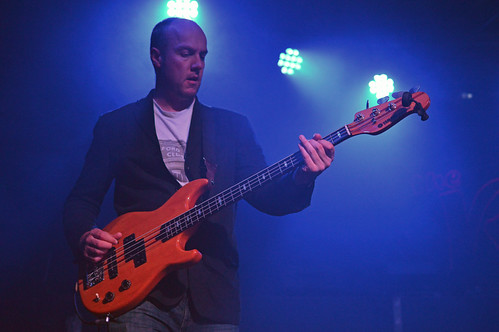
Review: Steven Wilson, Warwick Arts Centre 15.3.18

The Warwick Arts Centre is something or other in order to fluff out an appropriate beginning to a review.

British musician Steven Wilson has spent the best part of twenty years on an uphill slope to mainstream exposure. Leading the much-missed Porcupine Tree for the first 100 years of his career, after putting them on ice and embarking on a successful solo jaunt he has continued to draw in audiences and earn a well-deserved reputation for quality music and having a formidable live show.

Tonight, his tour in support of new 'progressive pop' album To The Bone brings him and superbly talented solo band back to home shores. Having previously graced beautiful European cities, where better to progress to than Coventry?

In the first of many highlights of this damp Thursday evening, the venue allow for a seat swap for a few extra quid after your correspondent got the seating map the wrong way round and happily paid £40 for the back centre seat, instead of the front. Shelling out on the night results in being four rows from the front, sadly resulting in some of the impact of the impressive new visuals diminishing somewhat.

The Butterworth Hall is something of a large lecture theatre - the stage is about a foot off the ground, and there is a greater sensation of the performers and audience being in the same room, rather than the usual physical gap between both parties.


Pictured: record audience numbers


The setlist follows the same rough outline as previous tours: two main sets split by a twenty-minute piss break and some extra songs tacked on in the encore. It's generous in length, covering around 19 songs and indicating the same thoughtfulness Wilson gives to his music and which songs to show off - some mainstays of previous setlists face off against a smattering of new To The Bone material: Nowhere Now and Pariah kick things off, after a short film, Israeli musician Ninet Tayeb appearing on the new projection system, with the cinematic epic Pariah and the sliding tackle of People Who Eat Darkness, with another winning accompanying video from animator Jess Cope.

The very show itself is an inherent bonus, as Wilson already has the Midlands area 'covered' with an upcoming date at the prestigious Birmingham Symphony Hall, providing some relief to Coventrians sick of decades of venturing to neighbouring Birmingham to see a show. It's strange however that Wilson continues (self-deprecatingly and with self-awareness, however) to express personal preference for standing shows and the greater freedom of enthusiam-expression that they allow - yet every show on this leg is seating-only.

Surely every major region has a more rough-and-ready sticky-floored sweatbox to accommodate (step forward, Wolves Civic) to balance out the swankier ones (good morrow, Symphony Hall), and Wilson could have trod the boards barefoot in, say, the Academy - offering as it would a combination of standing and seating.

Anyway.

Wilson gets around this somewhat by instructing the audience to stand for the grinningly defiant 'Permanating', where middle-aged curmudgeons get a boogie on and the stage - and the rest of the room - becomes a huge disco. It's so much fun you almost want a chunk of the show to carry on in the same vein. Wilson however faces a difficult task whenever he hits the road in choosing the right combination of material from his seemingly never-ending back catalogue, a rapidly expanding world that grows in size faster than you can get into it. Indeed, he has more hours of music to his name than there are people in the world.

Rubbish pic added to fill space


He always rises admirably to the task, however, and somehow manages to make unlikely bedfellows stand shoulder to shoulder in the set without any loss of theme, quality, or momentum. The much-loved Porcupine Tree track Arriving Somewhere... But Not Here opens the second set before the aforementioned Permanating and by some weird musical voodoo the two are unquestioningly Wilsonian yet are some of the most wildly different examples of Wilson you could place together.

As the man himself points out later, when doing a Billy Brag-style rendition of Even Less using just an electric guitar and none of his cohorts, there are tons of songs his slightly younger fans (i.e. under 40) never got the chance to hear, and they all his songs anyway, so Wilson continues to pepper his setlists with well-recieved renditions of Porcupine Tree tracks, slotting in surprisingly well alongside his solo material.

In celebration of Deadwing and In Absentia having long-awaited reissues on vinyl, surprising inclusions of The Creator Has a Mastertape and Heartattack in a Layby also appear - sounding so damn powerful you suddenly realise there are no barriers to what Wilson can draw from his extensive back catalogue (Storm Corrosion material has been played, never forget). Can we expect some Bass Communion on the next tour?

To The Bone's predecessors Hand.Cannot.Erase. and the 41/2 EP continue to survive into the new era with the deployment of instrumental Vermillioncore later in the evening, with Ancestral and Home Invasion/Regret #9 making welcome appearances during the opening set, continuing to feel at home just about anywhere despite being removed from the wider context of the Hand.Cannot.Erase. album. The sprawling Regret #9 guitar solo originally laid down by Guthrie Govan (in one take, legend has it) continues to be a litmus test for the prowess of Wilson's latest stringsman, and new recruit Alex Hutchings ably proves his worth on it.

Porcupine Tree's memory refuses to budge as the deathless (ha) Lazarus adapts well to the new visual presentation and the monolithic, lumbering beast of Sleep Together stomps around the room and erodes the vibrational integrity of the architecture with its downtuned power. While the prospect of the band ever functioning again continues to fadeaway (pun intended), Wilson's solo lineups continue to knock out impressive and satisfying renditions.

Song of I, Detonation and The Same Asylum As Before round out the rest of the second set, being Wilson's first ever 'sexy' song, another prog winner and a balls-out rocker respectively. The former gains more power in a live setting and continues to show off the new projection system and Detonation showcases the band's enviable tightness yet again.

The aforementioned just-Wilson Even Less finishes proceedings before the inevitable The Raven That Refused to Sing forms the habitual closing number. A Spinal Tap moment where the video fails to load on three attempts brings everything back to Earth a little, but without diminishing the show in any way - rather, an inadvertent opportunity to remind all present that for all the musical virtuosity and presentational bells and whistles, things can actually go wrong. It is quickly forgotten as one of Wilson's very best compositions draws an unforgettable evening to a close, and yet another unmissable tour by Steven Wilson gets properly underway.


Friday, 7 October 2016

Review: Opeth's 'Sorceress' casts its spell

Soldiering on through their new growl-free era, Opeth have either musicially neutered themselves or continued to push progressive boundaries with quality music, depending on who you ask.

Splitting their fanbase down the middle with 2011’s infamous (but really rather good) Heritage album, guttural growls and heavy riffing went out in the window in favour of a greater emphasis on haunting, autumnal atmospherics and slight noodling, all drenched in 70’s worshipping prog.

This turned away a sizable number in disgust, with the rest (and music publications) praising the resultant music for what it was, rather than what it wasn’t: and crucially, it was really fucking good. 

The same was said of 2014’s Pale Communion, which tumbled deeper down the prog rabbit-hole.
The naysayers can be forgiven, however, for while both Heritage and Pale Communion were excellent slabs of music in themselves, there was certainly something strangely different. 

Where the likes of past albums Blackwater Park, Still Life and Ghost Reveries were genuinely awe-inspiring, almost maddeningly inventive works hitting a high clang on the how-did-you-do-that register, Heritage and onwards are merely really-quite-good in comparison, destined to occupy an interesting spot in Opeth’s gleaming back catalogue but never to knock the twin giants of Ghost Reveries and Blackwater Park off their (deserved) high perches.

With this in mind (and in one’s ears), 2016 brings us the mysterious Sorceress. Boasting a title-track with the first heavy riffing of any kind since 2008’s Watershed, this new gilded release, essentially, continues onward from Pale Communion – as it should.

A straightforward return to death-metal stylings would carry a 99% chance of being an obvious rehash and lazy genre-milking, so hats must come off to Mikael Akerfeldt and co. for having the confidence to writing from the heart with more deliciously classy prog-rock.

So to an extent, the listener knows what to expect – piano, acoustic guitar, tasteful flute, looming keyboards, etc – and is rewarded in kind with more achingly beautiful instrumentation, inspired passages, haunting melodies and Akerfeldt continuing to be one of rock and metal’s most favoured sons.

Simply put, the quality bar is still endearingly high and Opeth have reliably rewarded those deciding to stick with them in a brave new musical world. Their classic past albums will always exist for those who prefer them, and the band have long since earned the right to do whatever they damn well please, and the results are fantastic.


Saturday, 31 October 2015

Turn to red: the legendary Killing Joke slay Birmingham

There are bands, and there are cults. There are concerts, and there are religious experiences. There are fanbases, and there are devout followers. 

There is an endless void, and there is Killing Joke.

Those wise enough to make this distinction and spend All Hallows' Eve crammed into Birmingham's Institute enjoyed a rollicking set of the Joke's special brand of indescribable purifying noise: cackling over the end of the world and presenting landscapes drawn from a sonic palette so indefatigably punishing and relentlessly brutal that it is, in its own way, unerringly beautiful. 


Touring in support of their fifteenth album, the shit-kicking Pylon, Killing Joke - returned to their original line-up after bassist Paul Raven's untimely passing, with a rare Absent Friends dedicated to him - take to the stage then take the stage itself, their autonomous zone for the night. 

Ploughing through an exploratory career-hopping set, due reverence is given to their position as venerable statesmen, with the tunes to match: a suitably boinging Eighties is judderingly relevant, despite being older than some of the crowd (hello). Pandemonium closes the set, after the likes of Turn to Red going toe-to-toe with the assault of newer cuts. 


Theirs is a tribal-industrial lot - if forced to categorize - pummelling the Institute and instigating a two-way energy exchange. Bassist Youth lighting incense sticks or whatever the fuck it was christ I'm tired who reads this shit anyway was a touching addition. 

Love Like Blood and Requiem, two foremost set staples, are tucked inside the middle of the set for once. Security lies in the understanding that the band could fart them through a kazoo and the respective gorgeous ache and fantastic stomp of these two would still transmit, and still incite no less applause. 


After thirty-eight (thousand?) years in the game, frontman Jaz Coleman is also no less the most hypnotic frontman of his generation. Still keeping any heel-snapping newcomers at bay, looking away is an impossible task as it is searingly clear from his expressions that every word carries megatons of weight, delivered accordingly. 


Guitarist Geordie Walker, meanwhile, is a mystery no easier to figure out even when working a few feet away. Chordal oddness and sheer inventiveness mixes with a guitar sound that is completely and utterly unmistakable, with bludgeoning riffing giving way to effortlessly illustrated textures, housed inside great cathedrals of sound, making his underrated status all the more criminal. 

Geordie Walker's Gibson ES-295: a conduit to chaotic noise

There are precious few acts where each and every member makes their mark through sheer force of personality as well as musical and technical skill. Skinsman 'Big' Paul Ferguson emits kidney-puncturing beats, perfectly undercutting the band's sound and quite possibly vibrationally eroding the venue's infrastructure. Aforementioned Martin 'Youth' Glover's driving bass dances around it wonderfully, fulfilling an overall sound that is, upon reflection, something not to be repeated. 


It is sobering to think of the oft-cited bands who Killing Joke left a (claw) mark on - the likes of Metallica, Tool, and Nine Inch Nails may command bigger audiences and their own degrees of fan loyalty, but know this: there will only ever be one Killing Joke, with an unrivalled intensity and singular identities of sound. Miss them at your absolute peril.


Tuesday, 27 October 2015

Still laughing: Killing Joke return with the incendiary 'Pylon'

Every few years, with the state of Planet Earth sinking utterly beyond satire and parody in its Nineteen Eighty-Five-on-steroids ruination, a certain collective pause to pass scathing comment upon it. This acidic dissent comes courtesy of messrs Jaz Coleman, Martin 'Youth' Glover, Geordie Walker and Big Paul Ferguson, trading unclassifiable apocalyptic disco-metal as the legendary and influential Killing Joke.

"Living outside of the grid is our goal! Misery lies at the heart of control," blares Coleman, resuming duties as messenger from the atomic wasteland in Autonomous Zone. Killing Joke's ideals are everlastingly precious and increasingly sensible, and are more often than not wielded as a bludgeoning device with which to beat some sense and wordly awareness into the listener.

And bludgeon, they certainly do: Ferguson commands a legion of skin-thwacking undercurrents that piercingly punctuates each nuclear missive, driven by Youth's submarine bass. Guitarist Geordie Walker's unique stringsmanship, an integral part of the Killing Joke sound since its inception, acutely divides his time between blunt-force-trauma riffing and wonderfully bleak soundscapes, matching Coleman's fustrated railings against mankind's descent.

Their knack for an immediately discernible and danceable tune is gratifyingly present and correct, with Euphoria and New Cold War proudly representing the band's fearless forays past the punk label in a time-honoured willingness to explore other avenues and nuke them.

Their primal ferocity is entirely compounded, aided and abetted by the same slickness that so enriched predecessor album MMXII. This production sheen may lend a slight cleanliness to the sound, but it in no way distils the message, like a celebrated film director employing modern touches to realise the artistic vision with greater clarity.

As is to be expected of such a self-aware and consistently thoughtful act like the 'Joke, the persistent question of mortality pervades (see also: Iron Maiden). Big Buzz also expertly treads between joyous anthem and teary emotion-trigger. A sense of celebration is one of their several alluring aspects, and this track harks back to the likes of On All Hallow's Eve, Honour the Fire and even Gratitude, where the doomishness is countered by Killing Joke's great sense of occasion: the self-styled Gathering.

In another parallel to Iron Maiden, they present their first double-disc studio effort. The second 'half' of Pylon, while feeling slightly like a tugboat trailing behind a battleship, still packs in four righteously furious pieces. It oddly ends with a remix of Snakedance, the original being curiously absent from the album. This prevents Pylon from sharing the sense of end-to-end completeness that MMXII had. Yet, Pylon has the key advantage of the expansiveness of double albums, and an abundance of such searingly strong music is not to be complained about.

With this, their fifteenth half-spat-half-sung commentary on a world continuing to circle the drain, Killing Joke have proven, once again, that the last laugh is theirs. Pylon is the mutated flower that grows through irradiated concrete: glimpses of ironic beauty in a diseased, dying landscape.


Friday, 19 June 2015

Review: Killing Joke - 'Killing Joke [2003]'

And there, in the title of this slab of pure fury brimming with intelligence, is the first warning to the uninitiated about the sheer size of Killing Joke’s colossal sonic testicles: that this is their second self-titled album.

This is entirely appropriate as a title, marking as it does a point of rebirth in the band’s history – a history that makes the story of your favourite band read like a council memo on lamppost legislation. The Joke are about as recharged as a musical act can be without actually spontaneously combusting: there is enough energy and sonic intent here to level cities.

Doubly interesting, then, that the band sound is completely stripped back, which pushes each instrument so far into your face that the collective aural beast manifests as a clenched fist. There is nowhere for the listener to take refuge, nor any let-up in the pacing. It’s the musical equivalent of a sound beating after spilling the pint of an intellectual.

And as usual, the forefront intellectual is Jaz Coleman – either a ranting, bug-eyed madman or one of the few to musically spew truth pearls into people’s faces in the hope that they’ll sit up and take notice (In this review, he is the latter).

Such is the skill, that fact is intertwined into memorable hook. ‘Five corporations earn more than forty-six nations!’ Coleman bellows on Blood On Your Hands. Total Invasion, meanwhile, has the sneering ‘Only fools won’t know, they haven’t been told/their empire’s run on the old black gold’. The sense of a shouted history lesson prevails.

The relentless barrage is also the great flaw of the album, one you don’t notice for a long time. Killing Joke pummel the listener senseless here, which is fine, as they do it with intelligence.

However, in concentrating on one of the things they do best, their other abilities are kept shut out, namely the talent in crafting danceable tunes and music with a sense of exploration and/or adventure, namely Bloodsport and Communion respectively as just two examples.


Nevertheless, for what Killing Joke is, it knocks out the competition with a swift knee to the balls and a diatribe on the state of the world. None do it better.

Ten Years On: The Darkness - 'One Way Ticket to Hell...and Back'

It's been a strange decade for The Darkness, having been through more ups and downs than the average rollercoaster, with more rock n' roll tales from ten years' worth of music than lesser mortals will endure in a lifetime.

Bursting into British popular music with shit-kicking debut 'Permission to Land' in 2003, the band enjoyed a hugely successful multi-faceted bullseye, totting up several victories in a short space of time: being the first unsigned band to sell out London's legendary Astoria and injecting much-needed life into rock's decaying corpse as it was being kicked around by indie hipsters.

As is often the case, a speedy rise ensures a similarly speedy descent, and the masses who bought into The Darkness' immediate popularity were suddenly nowhere to be seen for album number two, 'One Way Ticket to Hell....and Back'. A year after its release, frontman Justin Hawkins would underdo rehabilitation treatment for alcohol and coke addiction, leaving the band and leaving the remaining band to become Stone Gods. Hawkins, meanwhile, would return to action with the excellent Hot Leg.

While The Darkness are happily together again - albeit minus original drummer Ed Graham - history has a habit of passing (and pissing) over their unloved second album. Here, ten years on from its release, I wish to make the case for its recognition as one of the best British albums ever made.

Where 'Permission to Land' blew everyone's faces clean off with a giddily inspired mixture of snotty punk exuberance, near-perfect rock balladry, cannonball guitar riffs, Brit-wit and Hawkin's inimitable falsetto wail, the follow-up displayed a sense of world-beating maturity - but without losing the humour.

The impression from having listened to 'One Way Ticket...' more than my mother's voice is a disc where each gilded track stands impressively aloft on its own two flicked-v fingers, and still flows perfectly well in a single sitting. Where there was belligerence ('Get You Hands Off My Woman'), there was now a greater sense of scope and scale, with every single facet of the band sounding monstrously HUGE.

Hawkin's fantastic vocal range sears through each song in an impressive array of styles, a perfect narrator for chucklingly witty lyricisms. Who else can inspire childhood memories of school with the gorgeously anthemic 'Dinner Lady Arms'? The vocals are also produced to glossy perfection, with exactly the right amount of ghost-Justins popping up for sporadic backing vocals and harmonies.

Moving on to the music itself, there is the same subtle hints of serious guitar skills from Justin and brother Dan with considered deployments of widdly-widdly solos and acoustic flourishes, such as the verse to 'Hazel Eyes', which subsequently explodes into a chorus of mountainesque power chords and heaven-sent guitar licks, all the while punctuated with cannonfire drumming and powerful bass.

While almost every track is lyrically entrenched in lurve, the title track is a fantastically-told story of Hawkin's cocaine addiction: 'I always tried to keep my vices under wraps/but a coach-load of mutes would have been talkative chaps'. Setting the course for the rest of the album, there is spades and spades of sheer wit, catchy invention and polished-to-perfection balls-out rock.

There are absolutely no low points, perhaps except for when 'Bald' and 'Blind Man' get a little serious in tone. The sprawling gorgeousness of 'Seemed Like a Good Idea at the Time' is this album's answer to earlier single 'Love is Only a Feeling', and is an excellent sequel of sorts. While these songs burst a few of the party balloons momentarily,they are surrounded by bollock-burstingly-brilliant hymns that, above all else, must be applauded for being something that precious few bands seem to manage these days: FUN.

Like an unloved gifted child who turns to heroin during a traumatic parental divorce, 'One Way Ticket...' lay weeping in the corner as The Darkness underwent their meltdown. An incredible record such as this deserved far better in terms of a stable line-up to support it. A fat (middle) finger must also be pointed at everyone who enthused about their debut - hipsters and midlife crisis dads alike - who couldn't be arsed to stick with the band just as they produced their golden egg. 

Since their reformation, The Darkness have produced two more albums of knockabout British rock n' roll, thankfully carrying their hallmarks and ensuring their continued existence as a functioning band. But for a catastrophically brief moment in their history, at their most fragmented, a once-in-a-lifetime album was born in the worst possible conditions for its deserved recognition.

If you love witty, loud rock n' roll with just the right amount of polish and heart, I implore you to pick up a copy of this tragically overlooked album. It may just be the best thing you've ever heard.

10/10


Monday, 8 June 2015

Review: Muse - 'Drones'

The world continues to resemble an appallingly-written sci-fi movie by every passing day, so it feels especially righteous to have a fresh slab of music from popular rock's most endearing riff-wielding commentators, Muse. 

Album number seven, with the band noting a marked return to the primal guitar-bass-drums setup of their earlier works, comes with its own narrative: indeed, Matt, Dom and Chris have even expressed enthusiasm for Drones to be adapted into some form of musical.

Possibly to nix the allure of potential album leaks, Muse have pre-empted the release of Drones with not just the expected slew of singles, but approximately half the album. Psycho was the first out the gate, providing a musical home for a guitar riff that Bellamy has been throwing around for almost all of the band's history. 

The Drill Sergeant barking that precedes it is one of two interludes on the album, recalling Tool's fondness for such between-song pieces that allow the listener to breath and take a detour through disembodied planes before stumbling directly back into the album's narrative. 

Dead Inside followed, despite this Undisclosed Desires-turned-nasty stuttering disco stomper actually opening the album, possibly to allay fears of Bellamy talking a load of bells about the supposed return to Planet Rock. When received by the masses, it prompted confusion - it wasn't pureblood rock, but wasn't meat-and-potatoes either, proving Muse hadn't lost their appetite for exploration.

Next up, in both pre-album releases as well as Drones' actual running order, cometh Mercy and Reapers, which history may pinpoint as the overall album's standout tracks. Mercy proudly shows off its musical lineage, carrying several elements from past songs such as Starlight, Follow Me as well as setlist cornerstone Stockholm Syndrome, juicing the ingredients into a fantastic slice of glittercannon pop-rock.

Reapers takes the madness further with a so-so verse that gives way triumphantly to Rage Against The Machine-turned-glam guitar work, featuring a fabulously jubilant  - and dare I say it, sassy - guitar solo with the greatest chorus of the whole album. A surefire gem.

The Handler sits stubbornly at the album's core, guitar riff reaching out in several directions like a drowsy belligerent octopus. It provides the uneasiest experience amongst the tracklisting, but not without showcasing Muse's songwriting prowess.

The second of the interludes, JFK, features the great man himself blathering before Bellamy and co kick the door down with Defector, (yet) another monstrously rocking track that wields its hammerblow riffs and Queen-esque backing vocals, Matt in a pleasingly defiant mood that contrasts with the negativity preceding it over the course of some of the album's first half. 

After the usual dizzying carousel of thick-stringed riffery, bombast and epic themes, Revolt is a not entirely unpleasant prospect but its city-stomping predecessors leave such a mark that it nearly drops the baton. It may please those who wish for a simpler song, but history may consign it to the dusty corner of unloved filler tracks (see also: Explorers and Guiding Light).

Then again, it may be the intention to wind down the musical intensity as the narrative reaches its conclusion. Aftermath almost recalls the woozy sway of past tracks such as Blackout and the three-part Exogenesis Symphony, but is slightly too watery and ultimately fails to make a meaningful impression.

Ten-minute-monster The Globalist pointedly defies any notion of bringing things to a gentle halt with a heady mix of unadulterated fearlessness, albeit with slightly wobbly execution. Whilst not the greatest thing Muse have ever committed to tape, it inarguably succeeds in marking out Muse as one of the most interesting acts to tap the Top 10 on the shoulder before lending it a copy of 1984

Closing this chapter in Muse's history is the album's title track, in which Bellamy clones himself and forces the assembled Matts at Manson-point to all sing at the same time. It's a strange soup of the man exploring the different levels of his still-brilliant voice, but also sounds like several vocal warm-up takes being played at the same time. As album closers go, only time will have the final word on whether it truly works or not.

A cabal of longtime Musers wait, agonised, for Muse to return to the form they built their career and legend on. Drones doesn't completely hark back to those times, because nostalgia is a backwards glance and Muse have never done anything else except march into the future. For that, they cannot be criticised. 

7.5/10


Wednesday, 3 June 2015

Review: The Darkness - Last of Our Kind

Remember The Darkness? Spandex, 2003, I Believe in a Thing Called Love, Love is Only a Feeling, and a sophomore album that nobody liked or bought (despite Kerrang! magazine breathing one of their few remaining gasps of sanity and awarding the album their highest score)?

No?

Well, now's an excellent chance to either re-aquaint yourself with them or roll over and take their special brew of brilliantly silly carrying of the sacred rock n' roll torch.

As rock finds itself in arguably its weirdest state yet, album number four crashes down through the ceiling. Sequinned boots kick in all directions as the glammy force of the band's favourite form of gloriously OTT rock n' roll cheerfully bash your skull in (and out, like a hokey-cokey with Marshall Amps sponsorship).

Where thank-god-they're-back previous disc, Hot Cakes, had more of a lairy feelgood, um, feel to it, Last of Our Kind appears to wear brass knuckles underneath the velvet gloves. Witness the one-two punch of the first two tracks, Barbarian and Open Fire, notably uptempo shitkickers that carry a slight snarl with the expected snigger.

Handclapping anthems sway to the tempo alongside supercharged slices of rifferama, and suddenly the prospect of there being a dimension not containing this band is enough to scare you into grabbing a ticket for their winter 2015 UK trek, for at least one more chance to partake in the time-honoured Darkness party.

On other fronts, The Darkness continue to wear their rival-beating talents on their nipple tassels. Justin Hawkin's inimitable force-of-nature wail is present and deliciously unapologetic, delivering their amusingly inventive lyrical games with the expected alacrity. In a musical landscape oversaturated with unpalatable identikit bores, it is all too easy to

However, having worked so hard to develop their own take-no-prisoners identity and zippily identifiable character, along with a songwriting nous that has set the bar giddily high for themselves (not to mention their catastrophically underrated second album), some tracks, perhaps inevitably, can't quite reach up to those heights.

It's an issue that permeated previous long-player Hot Cakes, a thoroughly solid romp that couldn't quite match the pure greatness achieved prior. Taken as a standard rock album, however, it was by no means without identifiable merit.

Whether Last of Our Kind can be deemed a victim of the same problem can only be determined with 999 more listens and the fullness of time. What can be immediately ascertained, however, is that it is another secured victory.

7/10

Friday, 29 May 2015

Paul Together Now: Sir Macca Brings His 'Out There!' tour to Birmingham

Few, if any, stand bigger in the pantheon of aren’t-you-dead-yet pop stars than Paul McCartney. Having sold more albums than there are stars in the sky, with a ready repertoire of the most enviable hysteria-inciting pop hymns known to man, delivered by a backing band with more chemistry than a Breaking Bad binge, few have aged as gracefully as Macca.

McCartney is currently carbon-dated at 72, yet all external evidence defies this – the hair, the between-song sassy banter, and the sheer energy put his heel-snapping protégés to shame: the marathon length of tonight’s 40-strong set clocks in at a buttock-numbing two-and-a-half hours.

He and band bring an infectious energy and gusto to the proceedings, leading a hip-shaking conga through Beatles and Wings tracks rarely, if ever, aired before. The brave decision to leave the first undeniable gem until the third song – Can’t Buy Me Love – allows the far-travelled disciples to find their seats without missing the unmissable, but also sets a slightly sedentary precedent: with so much time to fill, Macca & Co set about darting around furtively in his glistening back catalogue. 

Unfortunately, that leaves slight gaps between the iron-clad hits.

The result sucks some of the momentum from the show. It is the way of all musicians, a problem so great that someone even of McCartney’s venerable statesmanship cannot escape: a shorter set of greatest hits, or a longer one that finds room for forgotten songs?

Deep cuts please the obsessive fans, but they are outnumbered by those who’d rather hear the immortal paens and go home again: the polarity in mid-song audience response is irritating, but thankfully allayed by rapturous arena-wild cheering after each song is put to bed.

Such quibbles are washed away when the immensity of a state visit from someone as celebrated as Macca is taken into account, along with the rarity of his visits (1990 – 2003 – 2015), and the sheer spectacle of it all. His voice, one of popular music’s immortal crown jewels, is understandably slightly ragged in parts. Thankfully, and in defiance of the natural ageing process, McCartney still greets each song with due respect, to satiating results.


8.5/10

Wednesday, 20 May 2015

Review: Faith No More - Sol Invictus (album)

For longer than anyone would admit to remember, in a moment of feverish 'Christ, I'm old' panicked realisation, Faith No More have been enthusiastically leapfrogging genres and expectations required of the ostensible rock band. Effortlessly embracing funk, rap, metal and everything else and soldiering it into their own bizarrely unique yet entirely accessible package, they have consistently proved themselves lovably versatile.

Fans who still can't get the taste of Angel Dust out of their ears need to calm down, however, as Sol Invictus stylistically seems to carry on where 1997's Album of the Year left off. This isn't to say Faith No More are stuck in their own past - instead, this new effort sits all the more comfortably next to its bigger discographical brothers.

For there isn't the effortless shit-kicking genius of their most celebrated disc, enveloped in an otherworldly alt-sheen, but instead the sound is far punchier. Sadly this means less atmosphere-creating synths from keyboardist Roddy Bottum, reduced to piano jingling here. However, the band don't sound like they are transmitting from a dimension of their own dimension - on Sol Invictus they have both arms down your throat, and Mike Patton's hydra-headed range of voices and styles finds copious employment, always to startling effect.

Lead single Motherfucker almost collectively drew an 'Oh' moment, considering the long wait for new material - prickteased by the band's reformation and series of gigs from 2009 onwards. It's a dark, brooding track that is almost entirely composed of a great slowly swelling buildup that overshadows its payoff, dissipating like a fart. The track sits strangely amongst its brethren, an odd choice for the band's first single in 18 years.

And the brethren it sits amongst appears to form its own musical rock face, better heard and easier appreciated as a dark and twisted whole. Few cuts stand tall with both fists flicking the V's, save the manic groove of Superhero.

But for a sorely-missed band such as these, not only is any return to action a cause for jubilation, the added bonus of a comeback album that isn't complete doo-doo is an absolute boon.

Tuesday, 19 May 2015

Review: Muse - 'Mercy' (Single)

As new songs from Muse's upcoming seventh album Drones break out like laser beams burning through the brick walls of the muscle museum, Matt Bellamy's claims of stripping back all the Queen-preening operatics, theatrics and vocal acrobatics in favour of good-old meat & potatoes rock is slowly being met with puzzlement from ardent fans.

First up was Psycho, a long-awaited musical home for a guitar riff almost as old as Muse itself, frequently tagged on to the end of certain songs live. It appeared to fulfil Bellamy's announcements of a grand return to planet rock, but was derided in some parts by whinging twats for being boring. Evident that you cannot please every bastard - especially when you're at Muse's level and can level entire stadia in virtually city in the star system, recruiting innumerable followers with every squealing slice of gargantuan lightsaber pop-rock.

Following this was Dead Inside, seemingly an about-turn from Psycho's primal riffery. Sounding like Undisclosed Desires' evil brother with its stuttering drums and bass, with Bellamy's guitar arriving late to the disco, it promptly split a lot of onlookers down the middle: either a disappointing continuation of the electro-pop leanings that turned off a few fans, or a relief to hear that Muse were not about to cut off their musically curious side. Whatever indication it might have been of the eventual full-length, it was still pretty damn good.

Finally, we come to the very latest offering: Mercy. Referred to by one wag as 'Starlight Syndrome', referencing its gleaming pop sheen and teasingly chugging guitar forming part of the tapestry beneath Bellamy's ironically merciless soundcannon wail in the chorus, Mercy appears to perch between those two while clutching the severed central hook of Follow Me, air-punching single from previous long-player The 2nd Law.

The vocal-following piano notes of Starlight are present, with a dazzlingly bright production lifting the proceedings into the air and into the raised hands of the tour-following disciples. It veers off from there, however, by simply being more up-tempo, with one hand firmly around the listener's neck and another on their balls. 

But is it rock? Pop-rock, yes. Those looking forward to the promised balls-out ROCK may have to hope there are riffy gems posted deep amongst the Drones tracklisting, because Mercy doesn't appear to fit that bill.

What it does do, however, is provide Muse with (yet) another OTT pop-rock monster that features traceable lines back through their dynasty of increasingly signature brand of this sort of thing, shooting glitter-guns in several musical directions at once: a worthy successor to Starlight and Follow Me, perhaps as Drones' grand continuation of their process.

Long may it continue - who else manages to sound this big nowadays?


'Drones' is released June 8th.
Muse will bring Christ only knows what to the main stage at Download Festival 2015 on Saturday 13th June.

Listen to Mercy below:

Saturday, 9 May 2015

Review: The Smiths Indeed, The Robin 2, Bilston

Ah, the tribute band. A sad waste of musical ability pissed away on crowds of saggy-bottomed middle-aged fools who, for one night, pause the process of growing up - or, a harmless skip down the memory motorway? The deathless debate hangs in the air. If your tribute band is so good, why not pen some tunes of your own?

The curmudgeons' oh-do-cheer-up side of the argument is rightfully hit in the eye by gladioli chucked into the crowd by Jurgen Wendelen, The Smiths Indeed's Morrissey representative, as the four-piece shimmy into Still Ill.

The Smiths Indeed, Robin 2, Bilston

A glance at The Robin's sizeable crowd, buoyant and resplendent in all manner of Smiths and Morrissey t-shirts, and the argument is swiftly kicked in the shins, a night of blissful indie memories well underway.

This is in no small part down to the masterful note-for-note replication of The Smith's timeless hymns, each shot through with sufficient verve to render them with a gratifying freshness. The skilfulness of their act doesn't just replicate, it channels the historic much-loved odes to love, loneliness and everything else.

The Smiths Indeed, Robin 2, Bilston

Celebrating the 30th anniversary of The Smiths' No. 1 album Meat is Murder, every song from it is given spirited renditions, even the maudlin title track. For Panic, igniting a mass 'Hang the DJ!' chant in the room, Wendelen swings a noose around in one of many touches that superbly contributes to the act. He has the mannerisms, accent, weird dancing and, of course, the singing voice utterly nailed down.

Taking Bilston by the throat through just about every Smiths song you really wanted to hear (except your correspondent's favourite, Shoplifters of the World Unite - but no qualms here), we are fortunate to have a shit-kicking visualisation of what it must have been like to witness such a band in the flesh.

The Smiths Indeed, Robin 2, Bilston

Representing those who sadly couldn't due to age (or lack of it), I am all the more grateful for such an eerily imitative experience that, for one night, opens a portal into hitherto inaccessible sonic territory that all the grainy YouTube footage in the world can't quite compete with.

The Smiths, indeed.

Photographs from the evening: https://flic.kr/s/aHsk7wpKHL

All photographs © JH Stokes 2015. Anyone found nicking these shots will be spanked with a wet plimsol. 

The Smiths Indeed, Robin 2, Bilston

Bonus: short clip of Bigmouth Strikes Again -


Tuesday, 7 April 2015

Review: Jaz Coleman - Letters From Cythera

Being an avid fan of post-civilisation noiseniks Killing Joke, it was only natural that the semi-autobiographical tome from their lead visionary, Jaz Coleman, would wind up in my possession (and in turn, I in its possession).

Having spent over thirty years fronting a cross between an influential post-punk British institution and a secret society, as well as doggedly pursuing his own ideas of spiritual destiny, it was perhaps inevitable that a life built of up a thousand interesting stories would make for a fascinating one written down.

It's the exact kind of work you'd hope for from Coleman: Robert Anton Wilson's Cosmic Trigger with sprinkles of The Dirt-esque rock n' roll insights. The man warns that readers hoping for a straightforward (not a word ever associated with Killing Joke) rock n' roll autobiography are to be disappointed, as the book's focus is more towards Coleman's personal spiritual journey.

Yet, KJ fans will still lap up fascinating recollections of recording in Berlin during the cold war, inter-band fracas, science-fiction-esque individuals and drugs, drugs, drugs, all seen as they are through Coleman's kaleidoscopic self-effacing eyes. These flashes of memories contribute in no small ways towards illuminating the backstory of a band most deserving of insight, as their story trumps most for eye-popping revelations.

For the occultly uninitiated, Coleman's casual referrals to such things as the Quabbalah and Gematria may prove either baffling or enlightening, spring-boarding them into new territories (or in my personal case, re-igniting some research desires) as his story weaves on.

It all points to one undeniable fact: Killing Joke are, simply, the most interesting band of all time. There is something to them that far transcends the music, and Letters From Cythera lends some semblance of understanding to this beast directly from the figure at its still-beating heart.

Thursday, 19 March 2015

Review: Steven Wilson, Wolverhampton Civic Hall 18.03.15

The cult of Steven Wilson is surely reaching critical mass. It’s becoming increasingly difficult to imagine a gem of a musician staying hidden from the mainstream public for much longer, especially when he manages to surpass an already widely-acclaimed album, 2013’s haunting The Raven that Refused to Sing. Tonight he returns to Wolverhampton’s Civic Hall in support of his latest, the end-to-end perfection of Hand.Cannot.Erase, a breathtaking guide to Wilson’s musical repertoire and a concept that out-concepts most concept albums.

The man has consistently translated well to the live setting, and tonight builds upon great memories of when he and his formidably skilled band (Guthrie Govan on guitar, Nick Beggs on bass and Chapman Stick, Adam Holzman on keyboards, Marco Minneman on drums) last graced the Civic in 2013, breathing life into the proggy ghost stories of The Raven that Refused to Sing with poise.
And in a moment reminiscent of that tour, an overly-long introductory video opens the proceedings, Wilson and band drawing loud cheers when they take to the stage.

Later, the ensemble reel off the Porcupine Tree classic Lazarus. it’s debatable whether this is as deep a cut as fans would hope for when Wilson spoke of airing rare tracks from his songwriting career, but it’s a flawless rendition. Announcing the song drew some of the biggest cheers of the night, when Wilson mentions that certain songs were chosen for airings due to having relevant themes. It’s a touching moment that demonstrates the enduring love for Wilson’s ‘other’ band, Porcupine Tree, from which he seems to finally be stepping out from under. Given how unlikely future Porcupine Tree activity may be, it’s safe to bet that more than a few fans were glad to hear it, along with Sleep Together which rears its head later in the set.

As every song from Hand.Cannot.Erase. is played tonight, and in sequence, save the gentle Transcience, it’s tempting to wonder why they don’t go for the jugular and perform the whole album. A few Steven Wilson standards, such as the woe-is-me pop of Postcard, are conspicuously absent - such is the fate of songs belonging to a steadily growing back catalogue.

Despite these gripes, what actually transpires is note-perfect and emotionally charged; every delicacy and every stomp is acutely brought to life. It’s (another) testament to the team that Wilson has assembled, who now have several tours under their collective belt and have gelled admirably (take note, Axl Rose).

While the band could play with just a post-it note for visual accompaniment and still put on an amazing show, the music is brilliantly paired with dynamic lighting and artistically matching visuals that shed light on the slightly mysterious story of Hand.Cannot.Erase. Eventually, the giant veil from tours past drops over the stage for The Watchmaker, a reminder of Raven’s progressive beauty and fragility. Nightmarish visuals projected onto the veil adds another dimension to the song, and is hugely effective.

All too soon, it’s time to say ta-ta as the band creep into The Raven that Refused to Sing’s title track, a wonderfully moving piece that may be the most beautiful and simply perfect thing Wilson has ever created. While it feels odd at first to have the same closer as the last tour, absorbing the magnificence on offer reminds you that very few things on Earth could follow such a song, and indeed such an act as polished, imaginative and skilled as Wilson and co.

***** 10/10

Friday, 13 March 2015

Review: Muse - 'Psycho' (Single)

So. Matt Bellamy warned us (or soothed us) with tales of a stripped-back sound for the new Muse album, now absolutely, totally, properly confirmed as the blunt-sounding Drones. It's interesting to see that even the title retains the same minimalistic feeling as the music is supposed to, and the tracklisting for the impending album is almost entirely made up of equally blunt one-word song titles. So far, more blunt than a James Blunt family gathering.

It's some surprise, then, that new track Psycho is a musical long-awaited home for a guitar riff (known as the '0-3-0-5-0 riff') that Bellamy has been dicking around with for several years, Muse often launching into it by means of an outro to Stockholm Syndrome in concerts. This opens a debate: if the lead single is a queasy mixture of new and old, what can be said for the rest of the album?

Anyway, on to the single itself, which is pleasingly rocking, and feels like a spiritual successor to 2009 single Uprising in its steady fist-pumping pace. A drill sergeant features throughout, yelling at a soldier, while Bellamy yells 'Your ass belongs to me now!', a line which finely treads between being acceptable and just a bit cringeworthy - as is the swearing, which is either Muse flopping their balls on the musical table or trying slightly too hard to be edgy.

It may seem that they cannot win, as some will inevitably find Psycho's meat-and-potatoes approach boring, missing the sonic explorations of previous singles Madness and Follow Me, excellent songs that drew a collective 'Oh' from a large portion of the fanbase.

Here's hoping that Drones will be a blend of Muse's best traits; much-loved past albums such as Absolution and Black Holes & Revelations have successfully blended their ASDA-sized riffs, orchestral backings and sense of adventure immensely, while the subsequent The Resistance and The 2nd Law saw the quality barrier dip slightly. 

Muse have proven themselves as world-beaters several times over - hopefully they'll get right back where they belong, at the top of the pile.

Tuesday, 3 March 2015

Review: Steven Wilson - 'Hand.Cannot.Erase.'

Not one to either rest on his laurels or plough a particular musical direction ad nauseum, Steven Wilson has made a name for himself in energetically pursuing all manner of different styles and genres across various projects, spreading himself like peanut butter: a distinctive taste that is instantly recognisable against any background.

He is also keen on approaching music armed with a theme or story, as 2013’s magnificent The Raven That Refused to Sing proved: a haunting collection of musical mini-feasts, encompassing prog-rock, jazz, and based on ghost stories penned by the man himself.

2014’s Cover Version compilation was a perfect stop-gap between Raven and Wilson’s latest, being an unpretentious collection of covers (duh) and original compositions – reminding everyone of his ability to create intriguing and spellbinding music simply for the joy of doing so.

Having given his growing legion of disciples time to breathe, he returns with a concept that out-concepts most other concepts, the concept being (sorry) the story of a young woman who is swallowed up by the big city and is discovered dead in her bedsit, having tragically passed away years beforehand.

An interesting story in itself, a judder of significance permeates the proceedings when it transpires that the story is based on real events – an actual breathing, living, loving human named Joyce Carol Vincent. A documentary about Vincent, titled Dreams of a Life, had such an effect on Wilson that he took inspiration and ran with it – to the studio.  

We begin at the start of the album (where else?), the first of eleven intriguingly-titled tracks, First Regret. An instrumental piece, it sets the scene with seasick piano and electronic washes of atmosphere. Digital thumps appear underneath the piano, and more electro tomfoolery fills the space. It could have fitted on The Social Network’s soundtrack.

Sparse keyboard gently introduces 3 Years Older, a musically exhilarating rollercoaster of full-band adventures, a Rush-esque rush. As the track veers between exciting peaks and gentler troughs, it’s hard to not wish for a little more time to be spent exploring the various avenues that the piece hurtles down: it feels like a taster montage of songs from a full album. However, it is brilliantly weaved together – and tremendous fun.

The album’s title track then elbows its way to the front, with breezy pop-rock sensibilities. You can almost hear Wilson smirking as he reminds you that while he can drag the listener through twenty-minute prog epics (Raider II, from past album Grace For Drowning), he can ‘do’ pop with a flick of the wrist.

A further part of the unfolding story is illustrated with the wistful and subtle Perfect Life, where Katherine Jenkins narrates memories of the female protagonist’s former foster sister, over a gently building electronic beat that gradually reaches its full sonic height, revealing Wilson waiting in the wings to add soft vocals in the second half. The sensation of sad longing for a much-missed happy period abounds.

These first four tracks almost lull the listener into audio safety before Wilson drags you into the album’s meatier, if less hooky, core. The further you venture into the album (and thus the story), the further into madder musical territory you go. Thankfully, all those who trespass here will be rewarded.

Home Invasion takes a turn for the weird with a proper prog-out leading into alt-rock swagger, permeated by dreamy intersperses of Wilson’s distinctive layered vocals and guitar that floats along with him, before shazoomphing into Regret #9, essentially an elongated spacey guitar solo that never approaches the wrong side of indulgence.

In turn, it sets the stage for the fleeting and gentler Transcience, which simultaneously recalls the aforementioned Cover Version collection of mostly acoustic numbers, and even the wondrous past project Storm Corrosion, where Wilson teamed up with Mikael Akerfeldt and produced stunning atmospheric vistas that paid zero heed to established ideas of song structure, revelling in a tremendous sense of musical freedom.

We now come to the biggest bastard of the album, Ancestral, clocking in at thirteen minutes. Classical instrumentation shakes hands with more electronic beats, in a mixture that shouldn’t work, but Wilson bends unto his will and view. Like 3 Years Older before it, enough music is stuffed into it to fill a warehouse (or the last chunk of space on your phone’s microSD card).

Happy Returns, um, returns us to the piano melody in First Regret. This is the last we hear of Wilson’s female protagonist, and the lyrics alone are heartbreaking when thinking of the tragic Joyce Vincent’s final moments. Wilson is to be commended for helping the cause against loneliness, by imaginatively filling in the blanks for a life shared with nobody but Vincent herself. The track also recalls the slow climb and build of Perfect Life – it’s reminiscent of when non-linear films show the viewer a penultimate scene near the beginning, so when we reach that crucial moment, it is already strangely familiar.

If this is the case with Happy Returns, it works excellently. A musical sad smile shows as Wilson engages in lyric-free doo-dooing, acoustic in hand, before the whole piece dissolves into Ascendant Here On..., the album’s exeunt.  A gorgeously simplistic choir vocal is accompanied by considered piano notes, and the sound of children playing leads us out...along with the life of a young human being.  

As the world becomes more and more connected but increasingly impersonal, future generations would do well to recognize Hand.Cannot.Erase. as a commentary on our increasing social coldness, and the effects it has on our fellow selves, most of which go unseen by the absolute majority.

It’s a bewilderingly beautiful kaleidoscope with which to view the social network age; few will ever capture it so vividly. 

Friday, 27 February 2015

Review: Bumblefoot - Little Brother is Watching

Ron ‘Bumblefoot’ Thal hasn’t had a chance to properly grace us with his brand of methodical musical madness for quite some time. For those who wondered what the feck was up with Guns N’ Roses these days and investigated, you’ll be aware that Thal has spent considerable time lending his  guitar wizardry to them. Now his tenure may have reached a conclusion, and we have Little Brother is Watching, his first full-length since 2008’s Abnormal.

And boy, is it welcome. Brilliantly bright lead guitars permeate Thal’s signature flavours of slightly cartoonish modern pop-rock eccentricities, where a vocal hook takes residence in your brain and forces you to hum it, before he utilises his stunning string-melting shredtastic sorcery and tastefully kicks the door down with a good old guitar solo.

Indeed, one of Thal’s many gifts is to know exactly when to unleash his formidable ability and give a song just the right guitar solo: he also knows when not to, proving equally adept at allowing his axe to sing in its own voice that melodically duets with the music – and with Thal’s own voice, which is impressive in itself.

Abnormal was seen as the ‘evil twin’ to 2005’s bright-eyed Normal, and appeared to take on a punk edge to some of the tracks, with cuts like Piranha proving ferocious. Little Brother is Watching places itself unapologetically in the pop-rock arena, with witty and touching lyricisms duelling with tasty riffs, singalong leads and distinctive vocals that deserve to help establish Ron Thal as a force to be celebrated.

Overall, Little Brother is Watching already has the competition pinned to the wall. If there is a God, it will coax listeners away from mainstream pap and towards a multi-talented, honest and musically fearless individual who has proven himself capable of great things and worthy of your attention.


He’s far more than a Bumblefootnote. 

Sunday, 22 February 2015

Review: The Death and Resurrection Show (Killing Joke documentary)

It’s brass monkeys, as they (probably) say, as a February wind tries to shove me off-balance into a passing mobile library. I am snaking through to London’s South Bank, miles from the sacred ground where a band called Killing Joke would have first formed and fought, a million years ago.  I pass pockets of tourists, and fail to find a bin for the banana skin I am carrying.

Entering the BFI building, a wary eye is kept out for Killing Joke’s frontman, Jeremy ‘Jaz’ Coleman, due to participate in a Q&A session after the film. A volcano-throated mystic who has spent nigh-on three decades fronting one of the most influential bands to tour the Earth, Killing Joke have probably made a mark on a band you like and you don’t even know it. Metallica? Check. Tool? Check. Nine Inch Nails, Ministry, Prong, Soundgarden? Check.

Oh, and Nirvana’s memorable Come As You Are bassline? Go listen to Killing Joke’s Eighties.

Those who could be here tonight are wandering around the building, easily spotted. I spare a thought for all of those who couldn’t make it, and perhaps the most-missed brother of all: Paul Vincent Raven, Killing Joke’s long-term bass player. In a wondrous example of triumph over tragic, Raven’s untimely death in 2007 was the catalyst for the original line-up to reunite. Faced with their mortality, the force-of-nature alchemical combination was restored.

After a series of reunion concerts, 2010 saw the release of Absolute Dissent. A wide-eyed and abrasive slab of noise, it still touched on moments of beauty, not least The Raven King: the Joke’s musical send-off for their fallen comrade.

Having established their return and reaffirmation, the more musically considered MMXII shot out of the portal in 2012. Still packing enormous sonic punch, the Joke painted with more colours from their musical pallet. Here they kept a watchful eye over the impending collapse of mankind, taking in the magnetic shift of the Earth’s poles, the construction of FEMA internment camps in America, solar flares wrecking Earthly electrical systems, and that old chestnut, the end of the world.

Back in London, it is time to sit and gawp at an admirable attempt to tell the story of this extraordinary outfit: The Death And Resurrection Show. Killing Joke’s circus is in town, as is their ideal of ‘the gathering’, as grown-up punks momentarily take over the bar and seating areas.  There is a great sense of occasion, but on a small, humble scale, where softly-spoken voices of reunited friends are moved to joyous laughter. The time eventually comes for everyone to pile into the screen room, and the usual kerfuffle over seats ensues.

The film itself is a treat, bravely pulling the dimensional veil back and allowing all gathered to spy on fascinating moments in the band’s history, intertwined with illuminating insights from current members, past members, associates and fans – including a pair of nobodies called Dave Grohl and Jimmy Page.

From a burned-down flat in Battersea, to the King’s Chamber in Egypt, to the Island of Iona, through the Basements of Hell in Prague, it’s a rollercoaster ride through the cosmos, laced with fascinating anecdotes and fantastical individuals. There doesn't appear to have been a square of the planet that the band haven’t touched, or touched upon.

 At the centre of it all is Jaz Coleman, the all-seeing eye of the storm. We see the progression of his remarkable life: from angry young school leaver to post-punk keyboardist, student of the theology, cult of personality (to the chagrin of drummer ‘Big’ Paul Ferguson, a figure of quiet dignity and a lingering wisp of fury), scourge of record companies and music journalists (do a search for ‘Jaz Coleman maggots’), eventually becoming something of a modern renaissance figure.

It would be rude not to mention Kevin ‘Geordie’ Walker and Martin ‘Youth’ Glover, a fiercely singular and innovative guitar musician, who provides much of the sonic textural backdrops for Coleman’s acid-spitting roar. Youth meanwhile provides a hippie-tinged foil, bringing a love of dub and dance to the mix and countering the doom-laden heaviness with his own artful spiritualism. The aforementioned Ferguson provides an approach to drumming not before seen in this dimension, described as his rhythms have been “like Garry Glitter on crack”.

The film stays remarkably true to the spirit of Killing Joke, by way of presenting chaos with a driven narrative, a sense of ‘background reins’, as can be detected in the band’s music – just the right amount of wrong, and thus the whole circus never quite collapses.

But thanks to The Death And Resurrection Show, we have further access than before on all the moments (and there are numerous) when the charade almost ground to a halt, from the infamous (and according to Coleman, much-misunderstood) fleeing of the singer to Iceland, to the reputation-buggering Outside the Gate, the magick-tinged battles of ego, and steadfast bassist Paul Raven’s tragic passing.

It is a double-edged sword that the film eventually has to finish, and there is no coverage of the band’s escapades post-Absolute Dissent – understandable, as by the time footage had been tacked-on to the documentary another chapter would have undoubtedly begun – and it is immeasurably tantalising to remember that Killing Joke is alive, well, and still laughing.

A Q&A session takes place afterwards as we collectively gasp for air and attempt to make sense of what has been seen: a story that would have been remarkable as mere fiction, let alone the actual history of a band. Fascinating anecdotes about the film’s troubled genesis are revealed, along with musical recollections from Coleman that tickle the assembled. Jaz is to be found later signing copies of his book, Letters From Cythera: A Ludibrium by Jaz Coleman. He patiently signs everything and poses for everything else. It’s especially surreal to have witnessed The Death And Resurrection Show and see the figure at its centre amicably chatting with those gathered.

After speaking with him on a resonance found in Killing Joke's music found wanting elsewhere, I stumble out into the night, the air laced with the taste of the Thames. I amble through the glow cast by the now-named Coca-Cola London Eye: another symbol of sheer wrong, as a bloated company steals even more space from your vision to flog you sugary liquid excrement. It’s just the sort of thing Killing Joke would froth and foam over, sonically pummelling you whilst also presenting the facts of the argument, such is their gift. Perhaps it’ll feature on the impending new album.

Walking up the steps to my hotel, a sudden slip sends me careering majestically back down. Luckily, it’s too dark for the Nikon-armed tourists to see me and capture my fall for posterity.


On the hotel step sits a banana peel.

The Joke is alive.